What the research shows
Letters are abstract symbols. When children first begin learning the alphabet, they must learn that an unfamiliar visual form represents a particular letter and connects to a spoken sound. Uppercase and lowercase versions can also look very different—like A/a, G/g, or R/r—even though they represent the same letter.
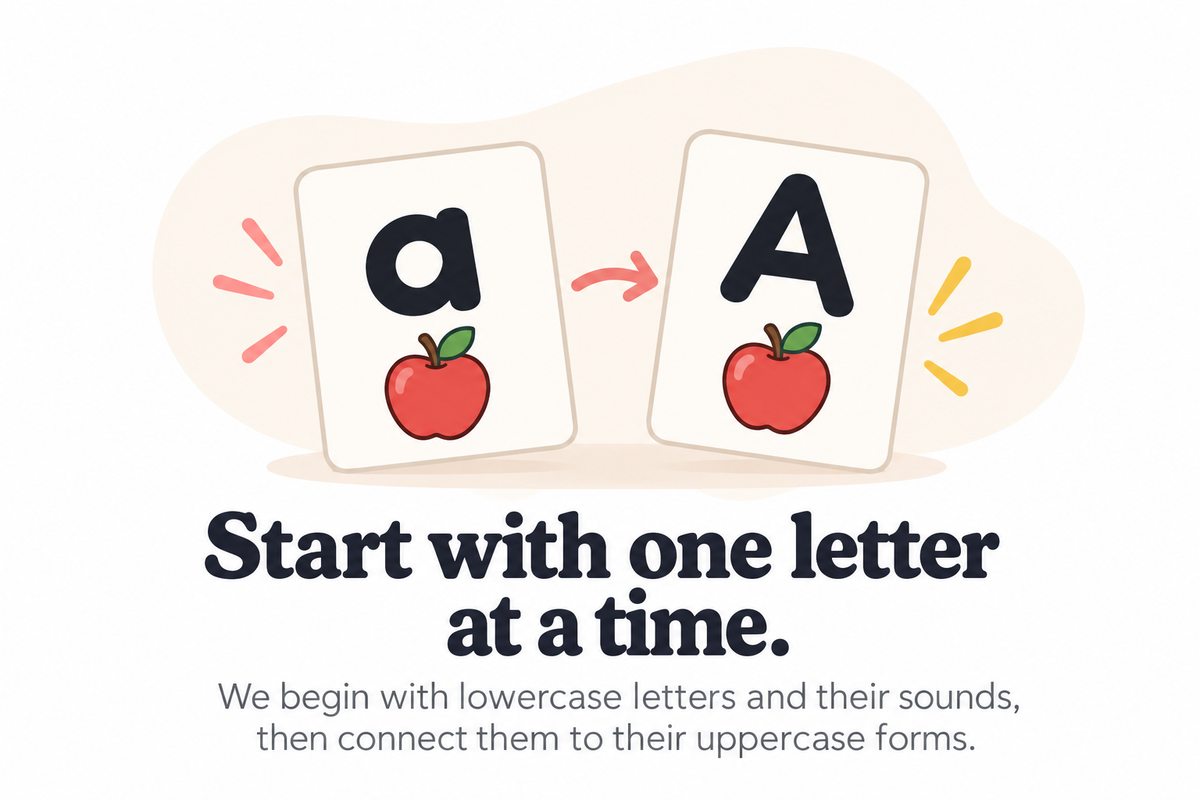
Because lowercase letters are the forms children encounter most often in written words, Fonexa simplifies this early learning process by introducing one form first: lowercase. Once children are familiar with lowercase letters and their sounds, uppercase letters are introduced and connected to the letter knowledge they have already built.
This approach reduces the number of new visual forms children are asked to learn at one time while still working toward the ultimate goal: recognizing both uppercase and lowercase letters and understanding that they represent the same letters and sounds.
Somin Park & Shayne B. Piasta (2026). Alphabet Learning and the Uppercase Facilitation Effect. Annals of Dyslexia.
Children successfully learned lowercase letters through explicit instruction whether or not they already knew the corresponding uppercase forms. The researchers concluded that lowercase instruction should be introduced early and systematically rather than delayed until children master uppercase letters.
View study ↗Nicholas E. Fears & Jeffrey J. Lockman (2020). Case- and form-sensitive letter frequencies in children’s picture books. Early Childhood Research Quarterly, 53, 370-378.
Lowercase letters are the forms children encounter most often in books. Researchers analyzing children’s picture books found that lowercase letters appeared nearly 18 times as often as uppercase letters, highlighting the importance of helping beginning readers become familiar with lowercase print.
View study ↗Khara L. Pence Turnbull, Ryan P. Bowles, Lori E. Skibbe, Laura M. Justice & Alice K. Wiggins (2010). Theoretical Explanations for Preschoolers’ Lowercase Alphabet Knowledge. Journal of Speech, Language, and Hearing Research, 53(6), 1757-1768.
Journal of Speech, Language, and Hearing Research
View study ↗